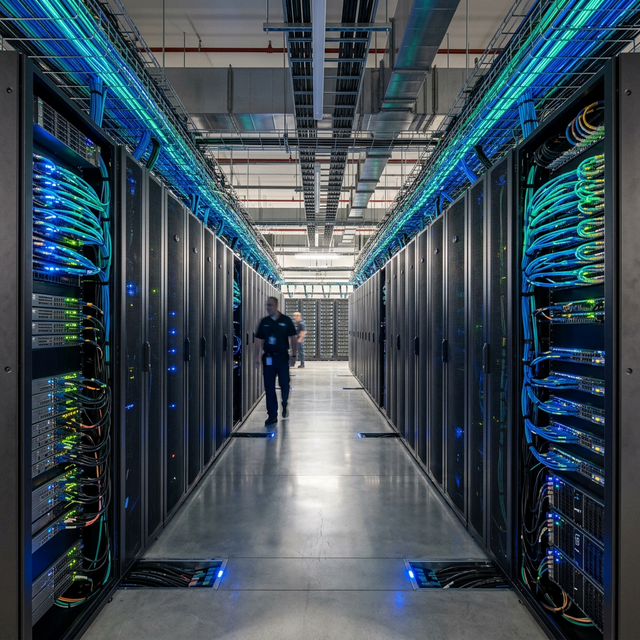
Fiber Network Architecture Design
Modern data centers depend on high-capacity fiber networks to operate reliably and efficiently. Data Net Axis engineers design the connectivity architecture that enables these systems.
Our engineers create comprehensive fiber network designs that support both current infrastructure demands and long-term capacity growth. This process includes planning backbone routes, fiber distribution layers, redundancy strategies, and connectivity pathways.
- ➔ Fiber backbone topology planning
- ➔ Redundant path architecture
- ➔ Fiber count planning
- ➔ Network distribution architecture
- ➔ Connectivity between telecom rooms and data halls
High Level Design (HLD)
The High Level Design phase defines the overall connectivity architecture of the facility.
- Data center fiber topology diagrams
- Backbone route planning
- Meet-Me Room connectivity architecture
- Interconnect strategy between network zones
- Redundancy and failover planning
- Future capacity planning
Low Level Design (LLD)
Low Level Design provides detailed engineering documentation used during installation.
- Detailed fiber routing diagrams
- Patch panel layouts
- Splice panel configurations
- Cable pathway layouts
- Rack-level connectivity diagrams
- Fiber labeling and identification plans
Data Center Connectivity Architecture
Inside a data center, multiple connectivity layers link external networks with computing infrastructure. This layered architecture ensures scalability, reliability, and efficient infrastructure management.
Carrier Entrance Facility (CEF)
The secure entry point where telecom carrier networks connect to the data center.
Meet-Me Room (MMR)
A central interconnection hub where carriers, cloud providers, and enterprise networks connect.
Main Distribution Area (MDA)
The core network distribution point inside the facility.
Horizontal Distribution Area (HDA)
Aggregation layer distributing connectivity across data halls.
Equipment Distribution Area (EDA)
The final connectivity layer linking servers, storage systems, and network equipment.